


Why a Client-Side Construction Manager Changes the Outcome of a Luxury Renovation in Italy
As featured in CNN Travel.
In brief: On a luxury villa renovation in Italy, the architect protects the design and the contractor protects their crews. A construction manager acting as your client representative is the only person on the project whose sole obligation is to you. On a project run from abroad — through layered permitting, heritage authorization, and long artisan lead times — that single line of accountability is usually what separates a renovation that lands well from one that drifts in cost, schedule, or quality.
There is a question worth asking before any contract is signed on an Italian villa, and almost nobody asks it: when the interests on this project stop lining up, who is working for me?
It is not a cynical question. Most architects and most Italian contractors we work with are excellent, proud of their craft, and straight with their clients. But everyone on a construction site carries an obligation. The architect defends the design intent. The contractor defends their margin, their crews, and their own pace. The suppliers defend their lead times. None of that is wrong — it is simply how the work is structured. What is missing, unless you deliberately put it there, is someone whose only obligation is the outcome you are paying for.
We’re Gaston and Norma, the founders of Duoma Atelier — we left Miami for Rimini (CNN Travel covered our story), renovated our own Italian home, and now deliver turnkey renovations for owners who live abroad. Client-side construction management is the least visible part of what we do, and the part that most often decides how a project ends. Here is the honest picture.
Who Actually Works for You on an Italian Renovation
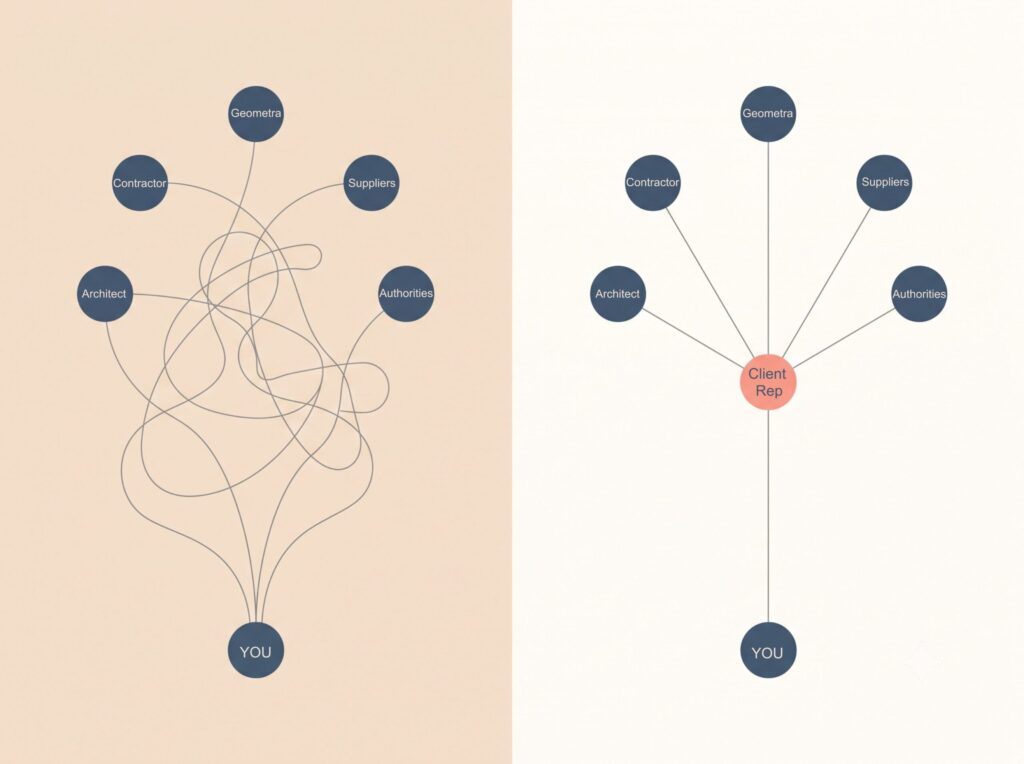
On a typical villa project an owner ends up in direct contact with five parties: an architect, a general contractor, a geometra or surveyor, a set of suppliers, and the municipality. Each is competent. None of them is accountable for the whole.
That structure is workable when you live twenty minutes away and speak the language. Run from another country, it quietly becomes a second job — one conducted by email, across a time difference, in technical Italian, with no way to verify what you are being told. Decisions get made because someone had to make them, not because they were the right decisions for you.
A client representative collapses those five relationships into one. You have a single point of contact who holds the others to account, and whose only obligation runs in your direction.
What a Construction Manager as Client Rep Actually Does
A client-side construction manager does not hold the trowel and does not draw the plans. They hold the project: scope, schedule, budget, quality, permits, and the dozens of small decisions that quietly determine whether a renovation feels effortless or exhausting. The distinction matters most in three moments.
When something unexpected is found.
Old buildings hide things — a beam that is not sound, a foundation that is not where the drawings say, a floor that turns out to be worth saving. Someone has to weigh the options against your budget and your intent before work resumes, not after. On a historic Italian property, mid-project discoveries are normal rather than exceptional.
When a change order appears.
Every change carries a cost and a time impact. Your representative prices it, documents it, and brings you a decision — not a surprise on an invoice three weeks later. Undocumented variations are the single most common source of dispute on a foreign-owned renovation.
When quality is arguable.
“Good enough” is a negotiation. Having someone hold a standard, on site, in Italian, with the authority to withhold a payment, is how a specification stays a specification.
This is where a commercial background earns its keep. We bring the documentation discipline of commercial construction — written scopes, tracked change orders, verified pay applications, punch-lists, formal closeout — to a residential project. It is unglamorous. It is also the difference.
Why Italy Raises the Stakes: Permits, Heritage, and Lead Times
Everything above is true anywhere. Four things make it sharper here.
Permitting is layered, and the layers do not run in parallel.
Italian building law grades work by how much it touches structure, volume, use, and façade: a CILA for non-structural interior work, a SCIA where load-bearing elements or the façade are affected, a permesso di costruire for changes to volume or use. Three to four months of design and permitting typically precede the first day on site. Where a vincolo applies, authorization from the Soprintendenza sits entirely separate from the municipal permit and typically takes three to six months from a complete dossier. Sequencing those approvals correctly, rather than discovering them one at a time, is a management task before it is a legal one.
The craft is real, and it moves at its own pace.
The artisans who do this work well — stone, stucco, bespoke millwork, restoration — are genuinely skilled and genuinely booked. Custom and heritage-appropriate elements carry lead times of three to six months, and longer for specialist stone and joinery. That is not a problem to be solved by pressure; it is a constraint to be planned around, which means committing to selections far earlier than most owners expect. Late procurement is one of the most reliable ways to stall an otherwise healthy project.

Language runs deeper than language.
Technical documentation is filed in Italian, in terminology that does not map cleanly from English construction practice. The harder gap is cultural: knowing which questions get answered by email and which get answered by standing in the comune, and how to hold a trade to standard without damaging a relationship you will need for eight more months.
The Italian calendar is predictable — and frequently ignored.
Holiday periods, seasonal weather, and supplier shutdowns are all known in advance. A schedule that does not account for them is not optimistic; it is simply wrong. Building them into the baseline is what allows it to survive contact with the year. On our projects the schedule is ours to write and ours to enforce — not something handed to us by the trades.
Cost Control on a Luxury Villa Renovation in Italy
Cost control on a project like this is not vigilance — it is process. Ours runs on a few fixed habits: materials verified against the specification and the price on delivery; labor reconciled against contract rates; a monthly variance review that explains every deviation in plain terms; and — this one matters most — no payment authorized until the work behind it has been inspected and accepted.
Three figures are worth holding in mind at the luxury tier: construction at €2,500 to €5,000+ per square meter; professional fees at 12–18% of construction cost; and a contingency of at least 10–15% on any historic property.
Foreign buyers consistently underestimate total cost by missing components rather than by mispricing the ones they know about. A complete budget carries construction, professional fees, permit and authorization costs including any regularization of prior unauthorized works, bespoke elements often contracted separately, furniture and soft furnishings, and a contingency that is genuinely set aside rather than notional. On a substantial project that contingency is real money — and on a historic building, some of it will be spent.
Documentation, Disputes, and Legal Compliance
Most renovations do not end in a dispute. The ones that do are almost always the ones where nothing was written down.
A client representative maintains the record as a matter of routine: contractor commitments, change orders, site instructions, inspection results, and performance issues, all documented as they happen rather than reconstructed afterwards. If a disagreement ever escalates, that record is the difference between a position and an argument. In the ordinary case, its real value is quieter — it prevents the disagreement from forming, because everyone knows what was agreed.
Compliance sits alongside it. Permits and authorizations, subcontractor licensing, insurance and safety obligations, seismic filings where load-bearing elements are touched, and the closeout documentation that certifies the finished work — each is a legal requirement rather than an administrative nicety, and each is far cheaper to satisfy in sequence than to remedy at the end.
What to Look For in a Client Representative in Italy
Not every firm offering oversight is offering client-side oversight. The markers that matter:
- Independence you can verify. Ask directly whether any part of their income depends on the contractor, the suppliers, or the volume of work. If the answer is evasive, you have your answer.
- A documented fee structure. A fixed fee or a clear percentage, free of hidden markups on materials or trades.
- Heritage experience. A track record of successful Soprintendenza authorizations cannot be improvised.
- Reporting as baseline, not as a favor. Weekly site meetings, photographic progress reports, and budget tracking should be standard practice rather than an upgrade.
- Authority to act. Oversight without the ability to reject work or withhold a payment is observation, not representation.
- References from a full cycle. Speak to foreign clients who completed a project — and ask how the team performed when something went wrong, because on any complex renovation, something always does.
The Honest Trade-Off
Client representation is a fee. It buys no marble and no square meters, and a project can be completed without it. We would rather say that plainly than pretend otherwise.
What it buys is narrower and, we would argue, worth more: single-point accountability, a documented record if a dispute ever arises, decisions brought to you clearly instead of consequences delivered late, and the ability to be an owner rather than a project manager. On a renovation of this size, run from thousands of miles away, the cost of getting the coordination wrong reliably exceeds the cost of getting it right.
The Honest Summary
A luxury villa renovation in Italy is one of the most rewarding things a foreign owner can undertake, and one of the easiest to execute badly. The ingredients of a good outcome are consistent: due diligence before purchase, permissions mapped before commitment, procurement started earlier than feels necessary, a budget that includes every component rather than the obvious ones, and one person whose sole obligation is to you.
You should be able to approve the vision, make the meaningful choices, sign what needs signing, and visit to see progress — not to firefight.
Wondering who would actually be looking after your interests on a specific property? Book a quiet, no-obligation conversation — an honest assessment of what your project requires, not a pitch. You can also browse our portfolio and how we work.
Related reading: what a high-end turnkey renovation in Italy really involves, and our guide to buying a luxury home in Italy.
Follow our design-and-build journey: Instagram · Facebook · LinkedIn · Pinterest
Figures reflect typical ranges on high-end projects and are not a quotation. Tax, VAT, and incentive rules change frequently and vary by municipality — confirm current specifics with a qualified Italian commercialista before relying on them.

